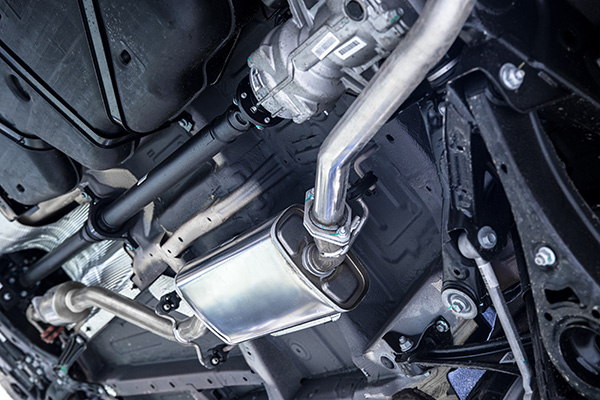
The flex pipe is one of those exhaust parts most drivers never think about until the car suddenly sounds louder than it used to. You may hear a ticking or raspy exhaust noise when accelerating, smell exhaust near the front of the vehicle, or notice a vibration that seems to come from underneath the engine.
Its job is simple but demanding. The flex section allows a small amount of movement between the engine and the rest of the exhaust system. Without it, normal engine movement would put much more stress on rigid exhaust pipes, flanges, and welds. Once the flex pipe cracks, that movement also makes the leak grow quickly.
Engine Movement Constantly Works the Flex Section
An engine does not stay perfectly still while it runs. It rocks slightly when you accelerate, shift into gear, or let off the throttle. The exhaust manifold or downpipe moves with the engine, while most of the exhaust system is supported farther back underneath the vehicle.
The flex pipe absorbs that difference in movement. Every trip makes it bend and relax thousands of times. After years of heat cycles and vibration, the braided outer material and the inner flexible section can fatigue. Small cracks often start at the ends, where the flex section is welded to the solid exhaust pipe.
Worn Engine Mounts Can Tear a Flex Pipe Much Faster
A flex pipe is designed to handle normal engine movement, not excessive movement. If an engine or transmission mount becomes soft, cracked, or separated, the drivetrain can shift much farther than it should.
That extra motion pulls, twists, and compresses the flex section every time you accelerate or change gears. At our shop, if a flex pipe fails unusually early or cracks more than once, we check the mounts before installing another pipe. Replacing the exhaust part without correcting excessive engine movement can put the new flex section through the same abuse.
Heat and Corrosion Weaken the Metal
Flex pipes operate in one of the hottest areas of the exhaust system. They can heat up rapidly during a drive and then cool back down every time the vehicle is parked.
Those repeated temperature changes gradually weaken metal. Water, road spray, and salt add corrosion from the outside, while condensation and exhaust gases work on the inside. The braided cover can still look reasonably intact even when the thinner material underneath has started to crack or separate.
Road Impacts Can Damage the Flex Pipe
The flex section often sits fairly low underneath the vehicle. A deep pothole, road debris, steep driveway, or contact with a curb can crush or bend the exhaust enough to damage it.
A hard impact can create more than an obvious dent. It can shift an exhaust hanger, bend a pipe, or place the flex section under constant tension. The pipe may not leak immediately, but the stressed area can crack later after repeated heating and vibration.
Signs of impact damage can include:
- A new exhaust rattle after hitting something
- Scrapes or flattened sections underneath the car
- Exhaust parts sitting closer to the body
- A flex pipe that looks stretched or twisted
- Noise that started soon after a pothole or curb strike
- A hanger or bracket that no longer sits correctly
Poor Exhaust Alignment Can Put the Flex Pipe Under Stress
An exhaust system should hang naturally without being forced into position. If previous exhaust work left the pipes misaligned, the flex section may already be stretched, compressed, or pulled sideways while the vehicle is sitting still.
That constant load shortens its life. We pay attention to how the system sits before welding in a replacement. A new flex pipe should not be used to force two badly positioned sections of exhaust to meet. Proper alignment and healthy hangers let the flex section do its job instead of carrying unnecessary tension all the time.
What Does a Leaking Flex Pipe Sound Like?
The sound depends on the crack's size and location. A small leak near the engine can make a sharp ticking noise that speeds up with RPM. A larger split often produces a deeper, raspy exhaust note when you accelerate.
You may also notice:
- Exhaust smell inside or around the vehicle
- Noise that becomes louder under load
- A metallic rattle near the flex section
- Black soot around a cracked area
- Reduced exhaust quietness at startup
- Vibration through the floor or pedals
Exhaust fumes entering the passenger compartment deserve prompt attention. Carbon monoxide has no smell of its own, so you should not rely on odor alone to decide whether an exhaust leak is safe to ignore.
Can the Flex Pipe Be Repaired or Does It Need Replacement?
A cracked flexible section is normally replaced rather than patched. Depending on the exhaust design, a shop may be able to cut out the damaged flex section and weld in a new one. Other vehicles use a flex pipe that is built into a larger downpipe or exhaust assembly.
During an inspection, we also check nearby flanges, hangers, mounts, and pipes for the reason the failure occurred. Regular maintenance can catch loose exhaust supports and deteriorating mounts before they place extra strain on the flex section. Fixing the cause along with the leak gives the replacement a much better chance of lasting.
Get Exhaust Flex Pipe Repair In Columbus, GA, With Auto Masters Repair
If your vehicle has a louder exhaust sound, ticking during acceleration, exhaust odor, or visible damage around the flex section, Auto Masters Repair in Columbus, GA, can inspect the flex pipe and surrounding exhaust components to find the source of the leak.
Schedule an exhaust inspection before a small flex pipe crack turns into a larger leak or damages nearby exhaust connections.