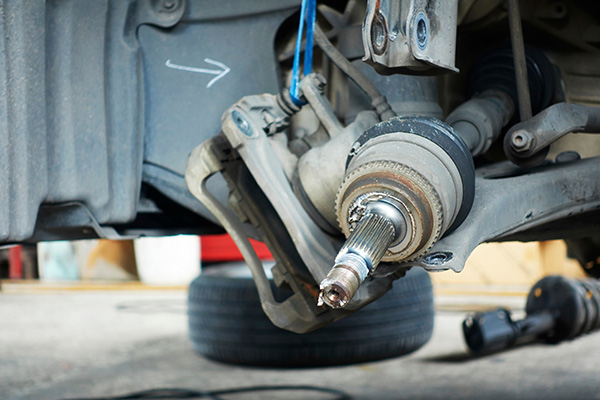
A clicking sound during a turn is one of those noises that quickly becomes hard to ignore. It may happen only in parking lots, during U-turns, or when pulling into a driveway with the steering wheel turned sharply. At first, the car may still steer normally and feel completely fine on the road.
The most common cause is a worn CV joint, but it is not the only possibility. Loose wheel-well panels, steering parts, suspension joints, and even tire contact can produce a similar sound. Paying attention to when the clicking happens can help narrow down where it is coming from.
A Worn CV Joint Is Often The Cause
Most front-wheel-drive vehicles use CV axles to send power from the transmission to the wheels. CV stands for constant velocity, and each axle has joints that allow it to keep transferring power while the wheels turn and the suspension moves. The outer joint works at its sharpest angle during tight turns.
As the joint wears, its internal bearings and grooves develop play. That movement creates a repeated clicking or snapping sound as the axle rotates. The noise is usually louder when accelerating through a turn and may seem to come from one front corner of the vehicle.
A Torn CV Boot Often Starts The Problem
Each CV joint is protected by a flexible rubber boot filled with grease. The boot keeps lubrication inside while blocking dirt, water, and road debris. If it cracks or tears, grease can be flung onto the suspension, wheel, or inside the tire.
Once the joint loses grease, contaminants enter and wear accelerates. Catching a damaged boot early may save the joint in some cases, but a joint that already clicks usually has internal damage. Installing a new boot alone will not undo wear that has already developed.
The Direction Of The Turn Gives Useful Clues
A worn CV joint may click more loudly when turning one direction than the other. During a left turn, the right axle is loaded differently, and during a right turn, the forces reverse. Noting which direction makes the sound stronger gives a technician a useful starting point.
Sound can travel through the floor and suspension, however, so the side you hear is not always the failed side. Both axles should be checked for torn boots, grease loss, looseness, and rough movement. Replacing the axle closest to the sound without first inspecting it can lead to the wrong repair.
Other Parts Can Click During A Turn
A loose wheel-well liner, splash shield, or mud flap can touch the tire when the steering reaches full lock. This often creates a lighter tapping or plastic clicking noise instead of the sharper rhythm produced by a worn CV joint. Oversized tires, aftermarket wheels, or missing fasteners can increase the likelihood of contact.
Strut mounts, ball joints, tie rods, sway bar links, and control arm bushings can also pop or click as the suspension loads during a turn. These parts may create one or two distinct sounds rather than a steady series of clicks. A noise combined with loose steering, uneven tire wear, or clunking over bumps points more toward steering or suspension wear.
How The Sound Helps Identify The Source
The pattern of the clicking is often more useful than the volume. A repeated click that speeds up with wheel rotation and becomes louder under acceleration strongly suggests an outer CV joint. A single pop as the steering changes direction may come from a strut mount, ball joint, or bushing.
A scrape or tapping sound only at full steering lock may indicate that a tire is contacting a liner or shield. Clicking paired with hopping or resistance during tight turns can involve an all-wheel-drive or four-wheel-drive system, especially if the tires have mismatched sizes or uneven tread depth.
Can You Keep Driving With The Clicking?
A CV joint that has just started clicking may continue working for a while, but there is no reliable way to predict how long it will last. As internal wear increases, the sound usually becomes louder and occurs during less severe turns. Eventually, the joint can fail and stop transferring power to the wheel.
Steering and suspension noises can carry even greater risk if a loose ball joint or tie rod is involved. Have the vehicle checked promptly if the steering feels loose, the car pulls, the noise becomes heavy, or the wheel shakes. Continuing to drive without knowing the source can turn a manageable repair into a roadside problem.
Why A Proper Inspection Is Worth It
A technician will usually start with a road test to reproduce the noise. The vehicle can then be lifted so that the CV boots, axles, steering joints, suspension components, wheel liners, and tires can be closely inspected. Movement that is difficult to see on the ground may become obvious once the wheel is unloaded.
Regular maintenance can catch torn boots, loose fasteners, and worn joints before the clicking grows louder. Finding the exact source also prevents unnecessary parts replacement, since several components around the front wheel can produce nearly the same sound from the driver’s seat.
Get Clicking Noise Diagnostics In Columbus, GA, With Auto Masters Repair
If your car clicks, pops, snaps, or rubs when you turn, Auto Masters Repair in Columbus, GA, can inspect the CV axles, steering, suspension, tires, and wheel-well components.
Contact us to schedule an appointment before a small turning noise develops into a more serious drivability problem.